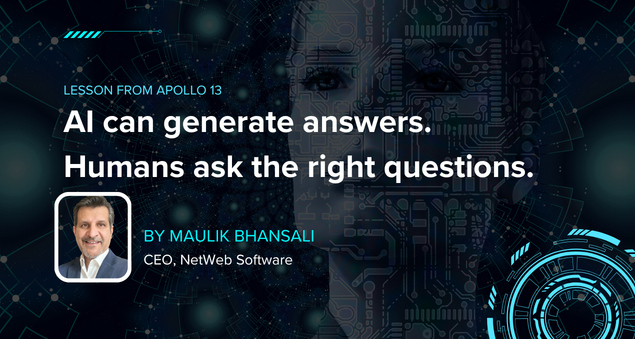
AI Can Generate Answers. Humans Ask the Right Questions.
When NASA faced the Apollo 13 crisis, the world’s most advanced technology at that time was already in place. There were sophisticated computers, engineering systems, telemetry data, and highly trained astronauts.
But when an unexpected explosion damaged the spacecraft in space, technology alone was not enough. What ultimately helped bring the astronauts back safely was human intelligence.
Scientists and engineers had to ask the right questions under immense pressure:
 What exactly is failing?
- What constraints do we now have?
- What is still possible with limited resources?
- How do we solve a problem no one prepared for?
The answers emerged because humans framed the problem correctly. And perhaps that is exactly what the AI era is demanding from us again and teaching us.
As AI systems become increasingly capable of generating content, analysis, code, designs, and decisions, the real differentiator shifts to something fundamentally human:
The ability to ask meaningful questions. Great questions require: Curiosity, Context, Critical thinking, Imagination, Intent, Wisdom.
AI can process vast knowledge.
But humans define direction. The quality of the future may not depend only on how intelligent AI becomes…but on how intelligently humans think, question, and guide it.
In business, leadership, innovation, research, and even daily life, better questions will create better outcomes.
Perhaps the future workforce will not only be measured by problem-solving abilities, but also by “problem-framing” abilities.
Because in the age of AI: Those who ask better questions may create the biggest impact.
About the author
Maulik Bhansali is CEO at NetWeb Software.He leads the company’s vision across Enterprise AI, digital transformation, and next-generation technology innovation. With a strong focus on building scalable and production-ready AI ecosystems, he works closely with enterprises to align AI adoption with business strategy, operational resilience, and long-term value creation. His perspectives focus on responsible AI, leadership thinking, and the evolving role of human intelligence in the AI era.